Custom Development vs. Templates: Why Top-Tier Consultants Need a Bespoke Digital Presence to Justify Premium Fees
In today’s competitive digital landscape, your website is no longer just an online brochure—it is your first impression, your positioning tool, and your most powerful sales asset.
Yet many consultants, advisors, and professional service providers still rely on generic templates to represent high-value services.
And here’s the problem:
 You cannot charge premium fees with a template-level presence.
In 2026, clients are more informed, more selective, and more influenced by perceived authority and trust signals than ever before. If your website looks like everyone else’s, you instantly position yourself as average—regardless of your actual expertise.
This is where the difference between custom development vs. templates becomes critical.
What Is the Difference Between Custom Development and Templates?
Before diving deeper, let’s clarify the fundamentals.
Why Templates Are Holding Consultants Back
Templates seem like a smart choice initially—lower cost, faster launch, less complexity.
But for top-tier consultants, they come with hidden costs.
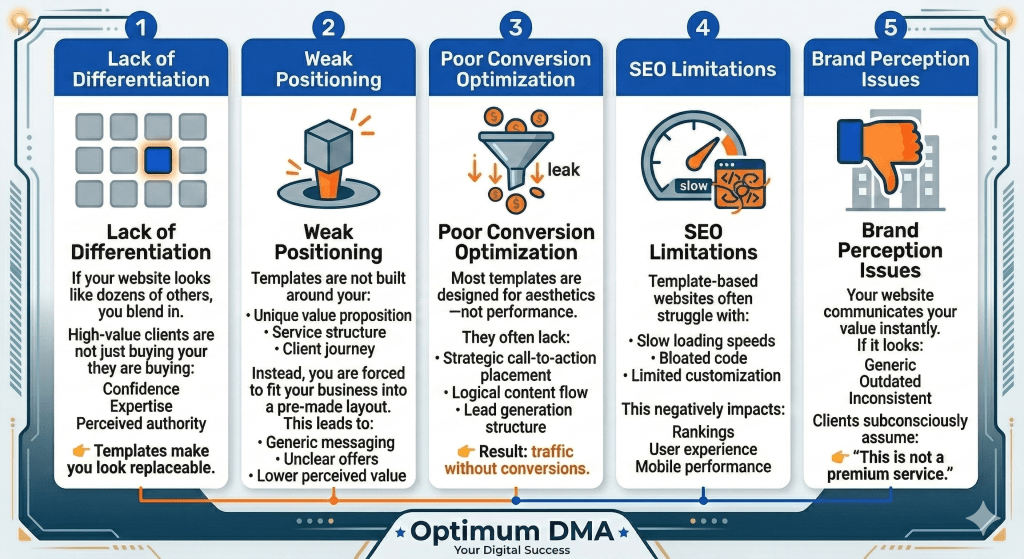
1. Lack of Differentiation
If your website looks like dozens of others, you blend in. High-value clients are not just buying your service—they are buying:
- Confidence
- Expertise
- Perceived authority
Templates make you look replaceable.
2. Weak Positioning
Templates are not built around your:
- Unique value proposition
- Service structure
- Client journey
Instead, you are forced to fit your business into a pre-made layout.
This leads to:
- Generic messaging
- Unclear offers
- Lower perceived value
3. Poor Conversion Optimization
Most templates are designed for aesthetics—not performance. They often lack:
- Strategic call-to-action placement
- Logical content flow
- Lead generation structure
Result: traffic without conversions.
4. SEO Limitations
Template-based websites often struggle with:
- Slow loading speeds
- Bloated code
- Limited customization
This negatively impacts:
5. Brand Perception Issues
Your website communicates your value instantly. If it looks:
- Generic
- Outdated
- Inconsistent
Clients subconsciously assume:
“This is not a premium service.”
Why Custom Development Wins for High-End Consultants
Now let’s flip the perspective. Custom development is not just about design—it’s about strategic positioning and growth.
1. You Control Your Positioning
A custom website allows you to:
- Highlight your expertise
- Structure your services clearly
- Guide visitors through a strategic journey
You’re no longer “just another consultant”—you’re a category leader.
2. Built for Conversion (Not Just Design)
Every element can be optimized:
- Headlines
- Layout
- Calls-to-action
- Lead capture points
This transforms your website into a client acquisition system.
3. SEO-First Architecture
Custom websites are built with SEO in mind from day one:
This gives you a long-term advantage in rankings.
4. Scalable and Flexible
As your business grows, your website should evolve with you.
Custom development allows:
- Easy expansion
- New features
- Integration with tools
Templates often become limiting as your business scales.
5. Premium Brand Perception
This is the biggest advantage. A custom website signals:
- Authority
- Expertise
- Confidence
And this directly impacts your ability to charge higher fees.
The Psychology Behind Premium Pricing
Here’s something many consultants overlook:
Clients don’t just evaluate your offer—they evaluate your presentation.
Your website answers key subconscious questions:
- “Can I trust this person?”
- “Are they experienced?”
- “Are they worth the investment?”
A template site creates doubt. A custom site builds confidence.
And confidence justifies premium pricing.
When Templates Might Still Work
To be fair, templates are not always bad. They can work if:
- You are just starting out
- You have limited budget
- You are testing a new niche
But once you reach a certain level:
Templates become a growth bottleneck.
Signs You’ve Outgrown Your Template Website
You should consider custom development if:
- You want to increase your pricing
- Your website is not converting visitors
- You look similar to competitors
- You are investing in SEO but not seeing results
- You want to build a strong personal or firm brand
Custom Website as a Business Investment
Many consultants see websites as an expense. That’s the wrong mindset.
A high-performing website should:
- Generate leads
- Build trust
- Support your sales process
It should pay for itself many times over.
Real-World Example
Imagine two consultants offering the same service:
Key SEO Benefits of Custom Development
From an SEO perspective, custom websites provide:
- Faster page speeds (ranking factor)
- Better internal linking structure
- Optimized content hierarchy
- Improved mobile experience
These directly impact:
- Visibility
- Traffic quality
- Conversion rates
This is known as social proof bias.
On websites, social proof appears through:
- Testimonials
- Case studies
- Client logos
- Reviews
- Performance metrics
Without these signals, visitors may hesitate — even if the service itself is excellent. Trust reduces friction, and reduced friction improves conversion.
How to Transition from Template to Custom
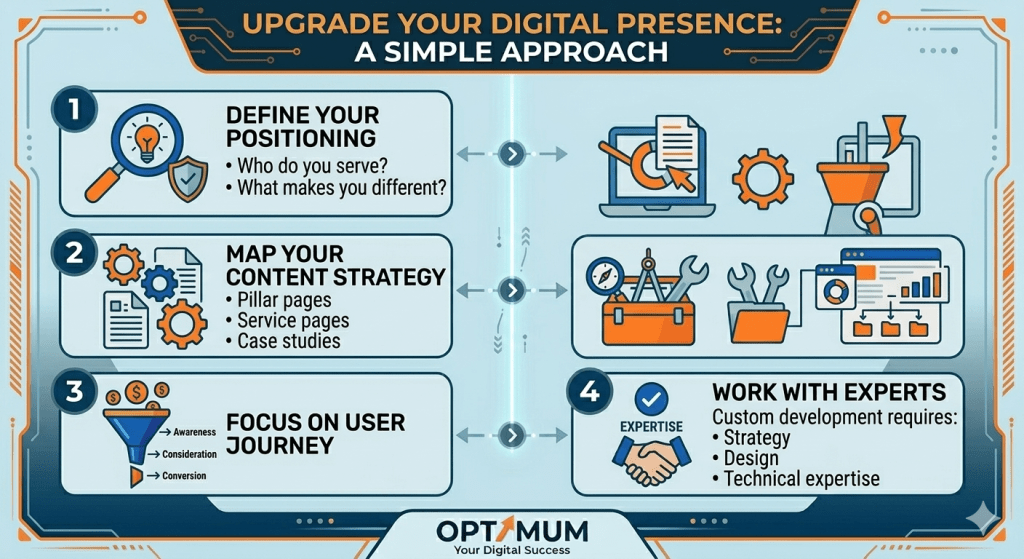
If you’re ready to upgrade, here’s a simple approach:
Step 1: Define Your Positioning
- Who do you serve?
- What makes you different?
Step 2: Map Your Content Strategy
- Pillar pages
- Service pages
- Case studies
Step 3: Focus on User Journey
- Awareness → Consideration → Conversion
Step 4: Work with Experts
Custom development requires:
- Strategy
- Design
- Technical expertise
Final Thoughts
The difference between average and premium consultants is not just skill—it’s perception.
And your website is at the center of that perception.
Templates help you launch.
Custom development helps you grow.
If you want to:
- Attract better clients
- Charge higher fees
- Build long-term authority
Then a bespoke digital presence is not optional—it’s essential.