


The Psychology of Website Design: 15 Principles That Reduce Bounce Rate
Table of Contents
Most people think websites succeed because of SEO. And yes, SEO matters. It brings people to your site. But what happens after someone arrives is determined by something else entirely: human psychology.
Visitors don’t analyze websites logically. They experience them emotionally and cognitively. In seconds, their brain decides whether to stay, scroll, trust, or leave.
Understanding these psychological principles changes how you approach design. Instead of decorating pages, you begin designing behavior.
One concept that often starts this conversation is attention residue. But in reality, it’s only one piece of a much larger psychological system that influences engagement, bounce rate, and conversions.
Let’s break down the most important psychological principles every modern website should consider.
Attention Residue: Why Visitors Arrive Distracted
One of the most overlooked factors in website UX is attention residue.
Attention residue occurs when someone switches tasks, but part of their brain is still processing the previous one.
Think about how people actually use the internet. They are rarely fully focused. A visitor might arrive on your website after:
- Checking email
- Answering a message
- Skimming another article
- Comparing multiple service providers
Their attention is fragmented. This means users don’t read your page carefully. Instead, they scan quickly while deciding if it’s worth focusing on.Good design respects this reality.
Effective websites reduce mental switching by using:
- Clear visual hierarchy
- One dominant message per section
- Minimal competing calls-to-action
- Strong structural flow
If a page forces the brain to constantly shift attention between competing elements, the visitor leaves. Not because they disliked the site — but because it required too much mental effort.
Cognitive Load: The Brain’s Processing Limit
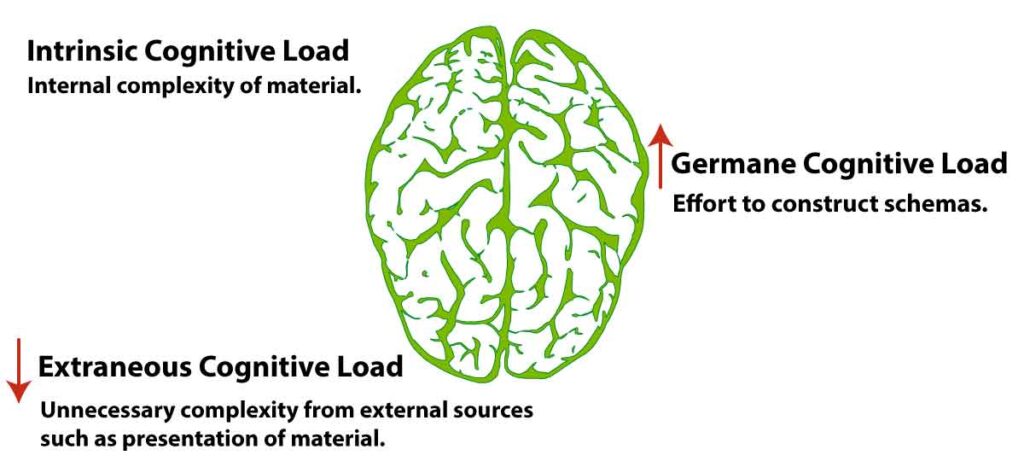
Human brains have limited processing capacity. Psychologists refer to this limitation as cognitive load. There are three types of cognitive load:
Intrinsic load
The inherent complexity of the information itself.
Extraneous load
The difficulty created by how the information is presented.
Germane load
The mental effort required to understand meaning.
In web design, your goal is simple: reduce extraneous load. Visitors should never struggle to figure out how your website works. This means eliminating unnecessary friction such as:
- Overly complex layouts
- Too many visual elements
- Confusing navigation
- Excessive animations
- Long blocks of text
Clean spacing, clear headings, and predictable layouts dramatically reduce mental strain.
When cognitive load increases, attention drops. And when attention drops, bounce rate rises.
Hick’s Law: Why Too Many Options Drive People Away
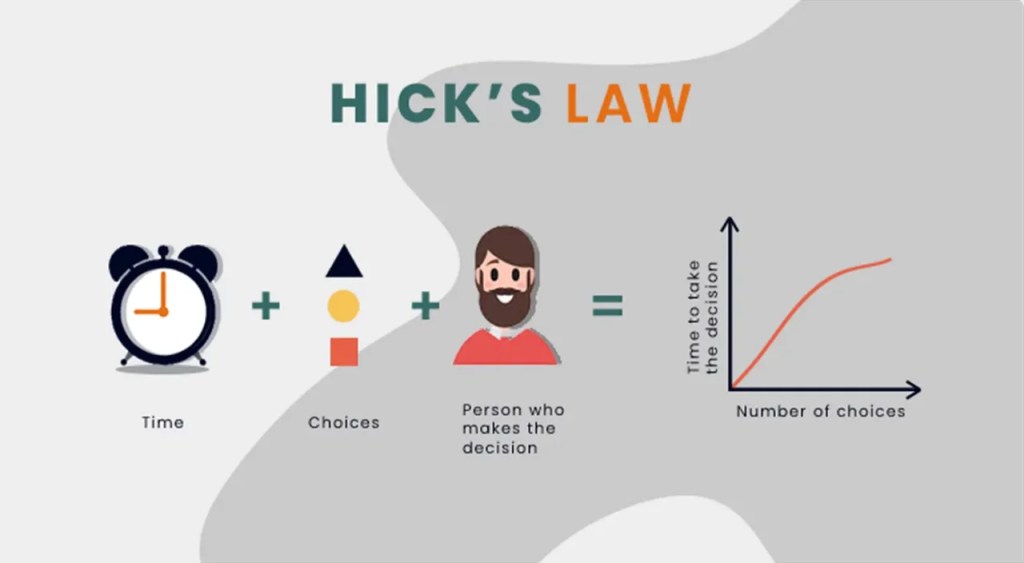
Another critical principle is Hick’s Law, which states that the more choices someone has, the longer it takes them to decide.
And the longer a decision takes, the more likely someone abandons it entirely.
Many websites accidentally create decision overload. A typical page might contain:
- Multiple service options
- Several call-to-action buttons
- Popups
- Navigation menus
- Promotional banners
Each additional choice adds friction. Strong websites guide visitors toward one clear action. For example:
Primary action:
Schedule a consultation
Secondary action:
Learn more about our process
Reducing choices simplifies decisions and lowers bounce rates.
The Paradox of Choice
Closely related to Hick’s Law is the Paradox of Choice. While people like having options, too many options can create anxiety.
Visitors begin asking themselves questions like:
- Which service is right for me?
- What’s the difference between these packages?
- Am I choosing the wrong option?
When uncertainty increases, people delay decisions. Online, delay usually means leaving the site. Consulting websites often fall into this trap by listing:
- Dozens of services
- Complex packages
- Multiple starting points
A better approach is to create a clear entry path, such as:
Start Here
or
Book a Strategy Call
Clarity removes friction and increases engagement.
The Primacy Effect: First Impressions Happen Instantly

Visitors form an opinion about your website in milliseconds. This is known as the Primacy Effect, where the first impression shapes all future perception.
People rarely analyze websites consciously. Instead, they instantly feel whether a site is:
- Professional
- Trustworthy
- Confusing
- Outdated
Several design factors influence this first impression:
- Typography
- Visual hierarchy
- Spacing
- Color balance
- Layout structure
A cluttered page creates subconscious discomfort. A well-structured page creates confidence. If the first impression feels chaotic or unclear, many visitors leave immediately.
The Von Restorff Effect: Why Contrast Captures Attention
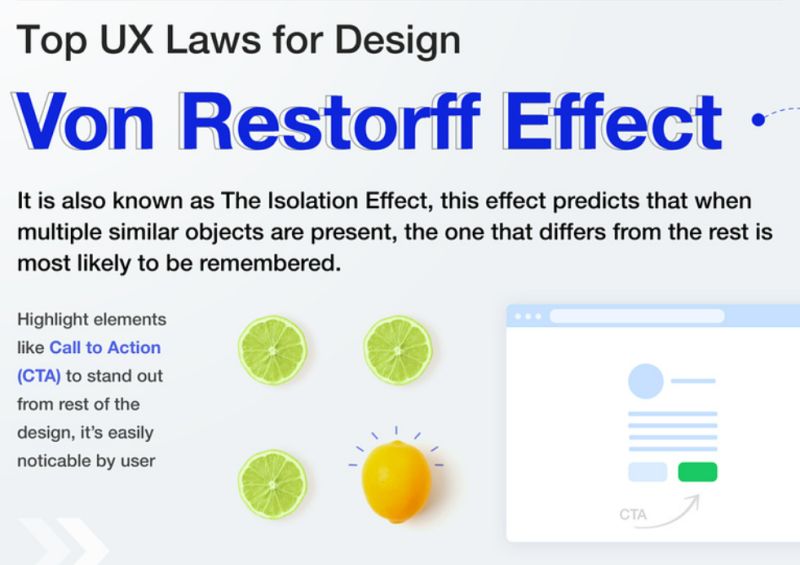
The Von Restorff Effect, also known as the Isolation Effect, explains why elements that stand out are more memorable. In website design, this principle is often applied to calls-to-action.
For example:
- A contrasting button color
- A highlighted offer
- A bold headline
But contrast only works when used selectively. If everything on the page is emphasized — bright colors, bold text, animations — nothing truly stands out.
Strategic contrast directs attention and improves engagement.
Scanning Behavior and the F-Pattern
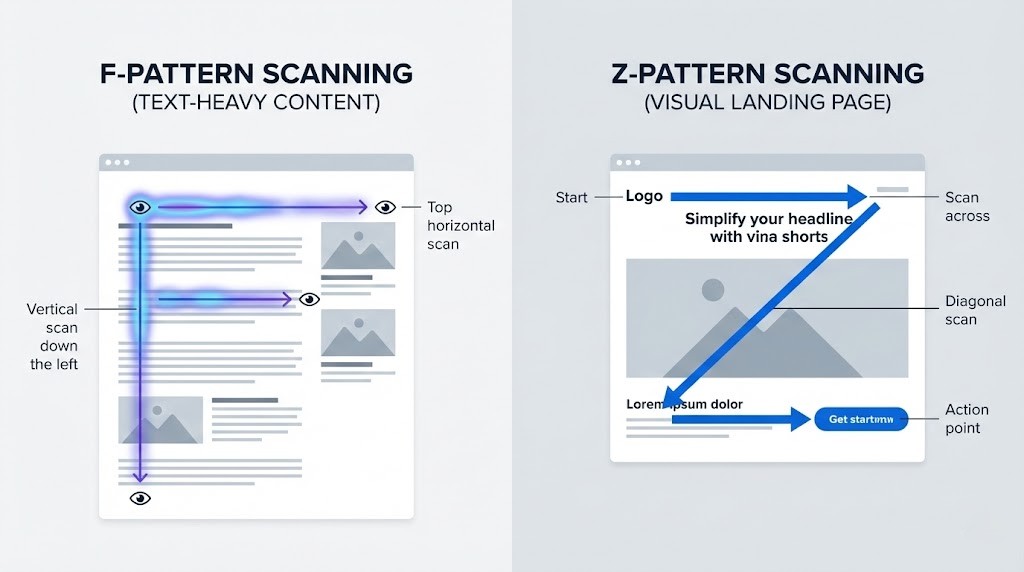
Eye-tracking studies consistently show that users scan webpages using an F-pattern.
They typically:
- Scan horizontally across the top
- Scan across a second line
- Move vertically down the left side
This scanning pattern explains why long paragraphs perform poorly online. Effective websites adapt by using:
- Strong headings
- Short paragraphs
- Bullet points
- Clear subheadings
Content becomes easier to scan, which encourages visitors to stay longer and continue exploring.
Humans rely heavily on social signals when evaluating decisions. If others trust something, we assume it must be credible.
This is known as social proof bias.
On websites, social proof appears through:
- Testimonials
- Case studies
- Client logos
- Reviews
- Performance metrics
Without these signals, visitors may hesitate — even if the service itself is excellent.
Trust reduces friction, and reduced friction improves conversion.
Loss Aversion: Why Fear Motivates Decisions
Psychologists have found that people fear losses more than they desire gains.
This principle is called loss aversion.
In marketing and UX writing, this can influence how messages are framed.
Instead of saying:
Improve your business strategy.
A stronger psychological message might be:
Stop losing opportunities due to unclear strategy.
Both statements describe improvement, but the second highlights the cost of inaction.
Effective messaging often acknowledges the problem visitors are trying to avoid.
Cognitive Fluency: Why Simplicity Builds Trust
The easier something is to understand, the more trustworthy it feels.
This phenomenon is called cognitive fluency.
When visitors can process information quickly, their brain assumes it must be reliable.
Improving fluency means focusing on:
- Simple language
- Clear layouts
- Familiar navigation patterns
- Readable typography
When a website feels effortless to use, trust increases naturally.
When something feels complicated, visitors subconsciously question its credibility.
Gestalt Principles: How the Brain Organizes Visual Information
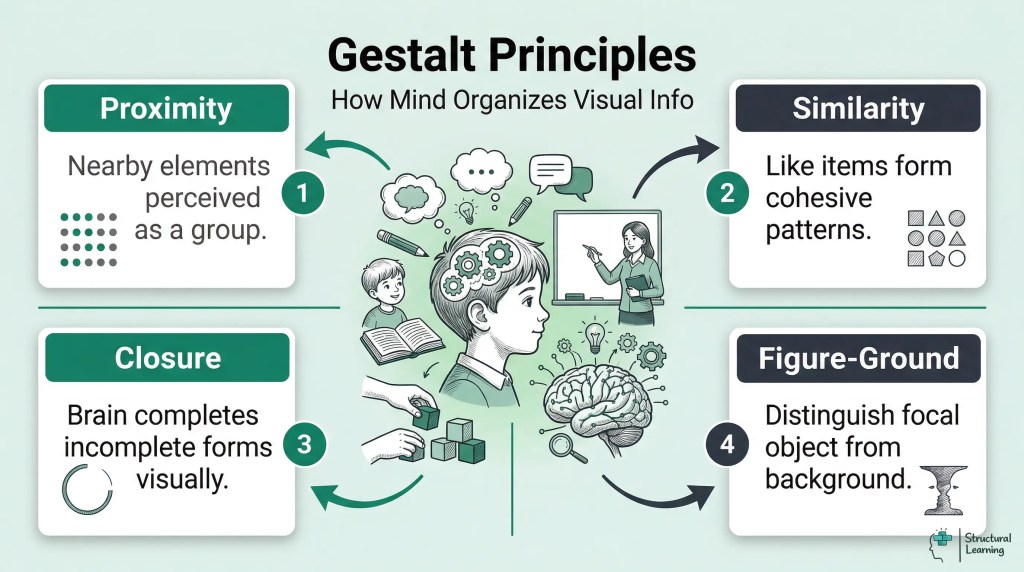
Gestalt psychology explains how the brain groups visual elements. Several Gestalt principles are especially relevant to web design.
Proximity
Elements placed near each other are perceived as related.
Similarity
Consistent styles signal connection.
Continuity
The eye naturally follows smooth visual paths.
Closure
The brain fills gaps in incomplete shapes.
When layouts align with these principles, websites feel intuitive and easy to navigate.
When they don’t, visitors experience subtle confusion.
The Zeigarnik Effect: The Power of Incomplete Tasks
The Zeigarnik Effect describes our tendency to remember unfinished tasks better than completed ones. This principle is often used in digital interfaces.
Examples include:
- Multi-step forms
- Progress indicators
- “Step 1 of 3” messaging
When users see visible progress, they are more likely to continue the process.
Completion psychology increases engagement and reduces abandonment.
Trust Heuristics: How Visitors Evaluate Credibility
Visitors subconsciously assess credibility through small signals.
They may ask themselves:
- Does this site look updated?
- Are there errors or inconsistencies?
- Is contact information visible?
- Does the company seem transparent?
Even minor design flaws can reduce perceived trust. Professional presentation signals competence.
Why Psychology Matters for SEO
Search engines measure how people interact with websites. Metrics like:
- Time on page
- Bounce rate
- Return visits
are influenced by human behavior.
If visitors quickly leave a site, it signals that the page did not meet expectations.
Psychological friction increases bounce rates. Reduced friction improves engagement.
Better engagement supports stronger SEO performance.
The Real Formula for Lower Bounce Rates
At its core, effective website design follows a simple psychological formula:
Clarity reduces anxiety.
Structure reduces cognitive load.
Trust reduces hesitation.
Emotion drives action.
When a website:
- Feels calm
- Is easy to scan
- Shows authority
- Offers a clear next step
Visitors naturally stay longer.
Final Thought
Many businesses assume their website struggles because of SEO. But in reality, the deeper issue is often psychological.
People leave websites because they feel:
- Confused
- Overwhelmed
- Uncertain
- Distrustful
SEO brings visitors to the page. But psychology determines whether they stay.
And when you understand how people actually think, designing a website becomes something much more powerful than visual design.
It becomes the design of human behavior.

About the Author
Nicky Huseynova
Founder & CEO, Optimum DMA
Nicky Huseynova is the Founder and CEO of Optimum DMA, a digital marketing agency focused on helping service-based businesses grow through strategic websites, SEO, and content marketing. She has worked with hundreds of U.S.-based businesses across a wide range of industries and has successfully led the launch of hundreds of websites.
Her work combines clear strategy, thoughtful execution, and a strong understanding of how people search, think, and make decisions online. From website development to SEO and content marketing systems, Nicky helps businesses build visibility, trust, and long-term growth.
 Connect on LinkedIn
Read Other Pro Tips
The Content Roadmap 2026: A Monthly SEO & Content Guide for Growing Professional Firms
Nicky H.
March 24, 2026
Local SEO for Law Firms: How to Show Up When Clients Search “Near Me”
Nicky H.
March 11, 2026

Blogging for Consultants: Build Authority & Attract Clients in 2026
Nicky H.
March 9, 2026
Whether you need a new website, SEO, or content strategy — we’re here to help.
We typically respond within 24 hours.
- 646-262-1142
- nicky@optimumdma.com
- Hell's Kitchen, NY 10019
Social Proof: The Psychology of Trust