


Types of Blog Articles: The 6 Core Formats and What Each One Is Used For
Table of Contents
If you publish blog content regularly, one question comes up sooner or later:
What kinds of blog articles should we actually be writing?
It sounds simple, but it matters more than most businesses think.
A lot of blogs fail not because the writing is bad, but because the format is wrong for the goal. Some articles are meant to rank. Some are meant to build trust. Some are meant to prove results. Some are meant to help readers make a decision.
When those purposes get mixed together, content becomes vague. It may look active, but it does not really move anything.
That is why understanding the main types of blog articles is useful. You stop publishing random posts and start building a content system.
Different SEO and content marketing sources categorize blog formats in slightly different ways. Ahrefs, for example, outlines 10 common blog post types, while HubSpot focuses on common formats like how-to posts and listicles, and Semrush emphasizes pillar pages and content hubs as major SEO assets.
But in practice, most business blogs revolve around six core blog article types. Everything else is usually a variation of one of these.
Let’s break them down clearly.
1. Pillar Articles
A pillar article is a broad, comprehensive piece of content built around one major topic.
It usually targets a competitive keyword and serves as a central hub for related articles. Semrush defines pillar pages as cornerstone content that covers a broad subject and links to more specific related pages, while Ahrefs describes content pillars as important for topical authority, internal linking, and ranking for competitive topics.
In simple terms, a pillar article is the page that says:
“If you want the full picture on this topic, start here.”
Examples:
- Complete Guide to Technical SEO
- SEO for Consultants: Full Strategy Guide
- Content Marketing for Accountants: A Practical Framework
What pillar articles are used for
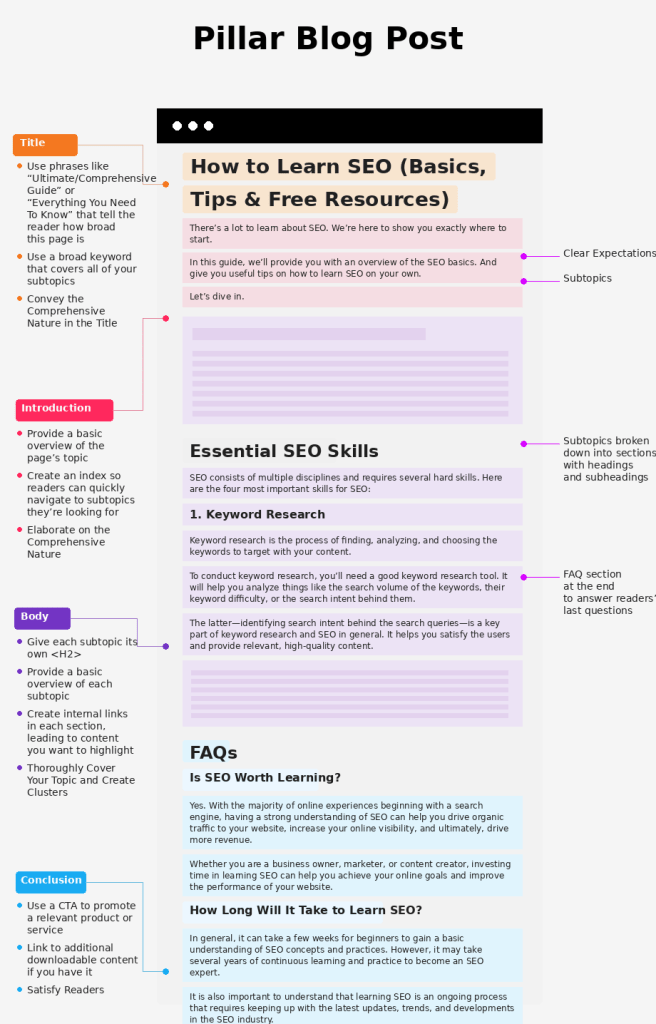
Pillar articles are mainly used to:
- build topical authority
- rank for broad keywords
- support internal linking
- organize smaller supporting articles around one subject
This is where many businesses get serious SEO value from blogging. A pillar article gives Google a strong signal that your site covers a topic deeply, not just once, but as a structured subject area. That is exactly why Semrush and Ahrefs both treat pillar content and content hubs as important SEO infrastructure.
When to use them
Use pillar articles when:
- the topic is broad
- you want to compete for strong search terms
- you plan to publish multiple related articles over time
If your blog is the skeleton of your content strategy, pillar articles are the spine.
2. Educational or How-To Articles
This is one of the most common blog post formats on the internet, and for good reason.
HubSpot highlights the how-to post as a core blog format, and it works because it solves a clear problem. People search online because they want help. A good how-to article meets that intent directly.
Examples:
- How to Improve Website Speed
- How to Optimize a Google Business Profile
- How to Reduce Bounce Rate on a Service Website
What how-to blog posts are used for

These articles are used to:
- attract informational search traffic
- answer specific questions
- build trust through usefulness
- introduce your expertise without sounding salesy
They work especially well when your audience is problem-aware but not ready to buy yet.
A strong how-to article says:
“Here is the problem, here is how it works, and here is what to do next.”
Why they perform well
They match natural search behavior. People often search with phrases like:
- how to
- what is
- why does
- how do I
That makes educational posts one of the strongest blog article types for organic traffic.
3. List Articles
List articles, or listicles, are often underestimated because they are so common. But when done well, they are one of the easiest formats to read and one of the easiest to share.
HubSpot notes that list posts are highly recognizable because they are organized around a numbered structure, and readers often find them easier to scan. Semrush also includes numbered blog post templates as a practical content format.
Examples:
- 10 UX Principles That Reduce Bounce Rate
- 15 SEO Strategies for Consulting Firms
- 7 Mistakes That Make Websites Look Untrustworthy
What list articles are used for
List articles are useful for:
- increasing readability
- improving scan-ability
- packaging complex ideas into simpler units
- encouraging sharing on social platforms
They work well because they reduce cognitive load. Readers know what to expect. Each section feels manageable. That matters online, where most people scan before they commit.
The catch
A list article becomes weak when it is only structure and no depth.
A good listicle is not just “many points.” It is organized insight.
4. Case Studies
Case studies are one of the most valuable blog article types for trust.
They show real work, real results, and real context. Ahrefs even publishes collections of SEO case studies because they are useful for both proof and learning.
Examples:
- How a Consulting Firm Increased Leads by 118%
- From Redesign to Revenue: A Website Case Study
- How SEO Improved Organic Visibility for a CPA Firm
What case study blog posts are used for
Case studies are used to:
- build credibility
- prove that your process works
- support sales conversations
- reduce buyer hesitation
A case study is different from a testimonial. A testimonial says:
“We liked working with them.”
A case study says:
“Here was the problem, here was the strategy, and here was the result.”
That difference matters. If educational articles bring traffic, case studies often help convert that traffic into trust.
When to use them
Use case studies when:
- you have measurable results
- your audience wants proof
- your service requires trust before purchase
For agencies, consultants, designers, SEO specialists, and service businesses, case studies are not optional. They are evidence.
5. Thought Leadership or Opinion Articles
Thought leadership articles are less about answering a search query directly and more about shaping perception.
They usually express a perspective, challenge a common industry assumption, or reframe how people think about a topic.
Examples:
- Why Most Agency Websites Fail to Build Trust
- SEO Is Not the Problem. Website Psychology Is.
- Why Overcomplicated Marketing Scares Good Clients Away
What thought leadership articles are used for
These posts are used to:
- build authority
- sharpen brand voice
- differentiate your business
- attract the right type of audience
They are especially powerful on LinkedIn and for service-based brands that sell expertise.
Not every article needs to sound neutral. Some of your strongest content comes from saying something clear, true, and well argued.
The risk
Thought leadership without depth becomes performance. To work well, these articles need:
- real observation
- clear logic
- a point of view worth reading
Done right, they help people remember you.
6. Comparison or Decision Articles
Comparison articles are built for readers who are closer to making a choice.
They often target high-intent keywords and are useful when someone is evaluating options.
Examples:
- WordPress vs Webflow for Professional Services
- SEO vs Paid Ads for Consultants
- Website Redesign vs Website Refresh: What’s the Difference?
What comparison blog posts are used for
These posts are used to:
- capture decision-stage traffic
- help readers evaluate options
- reduce uncertainty
- support conversions
This format works because it meets readers at a later stage of awareness. They already know the problem. Now they want clarity.
A good comparison article is not biased for the sake of selling. It is structured, honest, and useful.
That honesty is what makes it persuasive.

Why These 6 Core Blog Article Types Matter
Different blogs may publish many variations: FAQ pages, beginner guides, checklists, glossaries, templates, resource lists, and data studies. Ahrefs includes many of these as distinct types, such as checklists, templates, and expanded definition posts.
But most of them still sit inside one of these six larger categories.
For example:
- FAQ articles usually function as educational posts
- checklists often work like list articles
- resource hubs often connect back to pillar articles
- trend pieces often function as thought leadership
This matters because it simplifies your strategy. You do not need fifty random article ideas. You need a balanced mix of the right formats.
Final Thought
There is no single official list of blog article types. Different content and SEO publishers group them differently, and that is normal. But the core idea is stable: blogs work better when each article has a clear job.
If you understand the six core blog article types, you stop creating content just to “post something.”
You begin building:
- traffic intentionally
- trust systematically
- authority strategically
- conversions more naturally
That is when a blog stops being a content archive and starts becoming a business asset.

About the Author
Nicky Huseynova
Founder & CEO, Optimum DMA
Nicky Huseynova is the Founder and CEO of Optimum DMA, a digital marketing agency focused on helping service-based businesses grow through strategic websites, SEO, and content marketing. She has worked with hundreds of U.S.-based businesses across a wide range of industries and has successfully led the launch of hundreds of websites.
Her work combines clear strategy, thoughtful execution, and a strong understanding of how people search, think, and make decisions online. From website development to SEO and content marketing systems, Nicky helps businesses build visibility, trust, and long-term growth.
 Connect on LinkedIn
Read Other Pro Tips

The Content Roadmap 2026: A Monthly SEO & Content Guide for Growing Professional Firms
Nicky H.
March 24, 2026



Local SEO for Law Firms: How to Show Up When Clients Search “Near Me”
Nicky H.
March 11, 2026

Blogging for Consultants: Build Authority & Attract Clients in 2026
Nicky H.
March 9, 2026
Whether you need a new website, SEO, or content strategy — we’re here to help.
We typically respond within 24 hours.
- 646-262-1142
- nicky@optimumdma.com
- Hell's Kitchen, NY 10019